
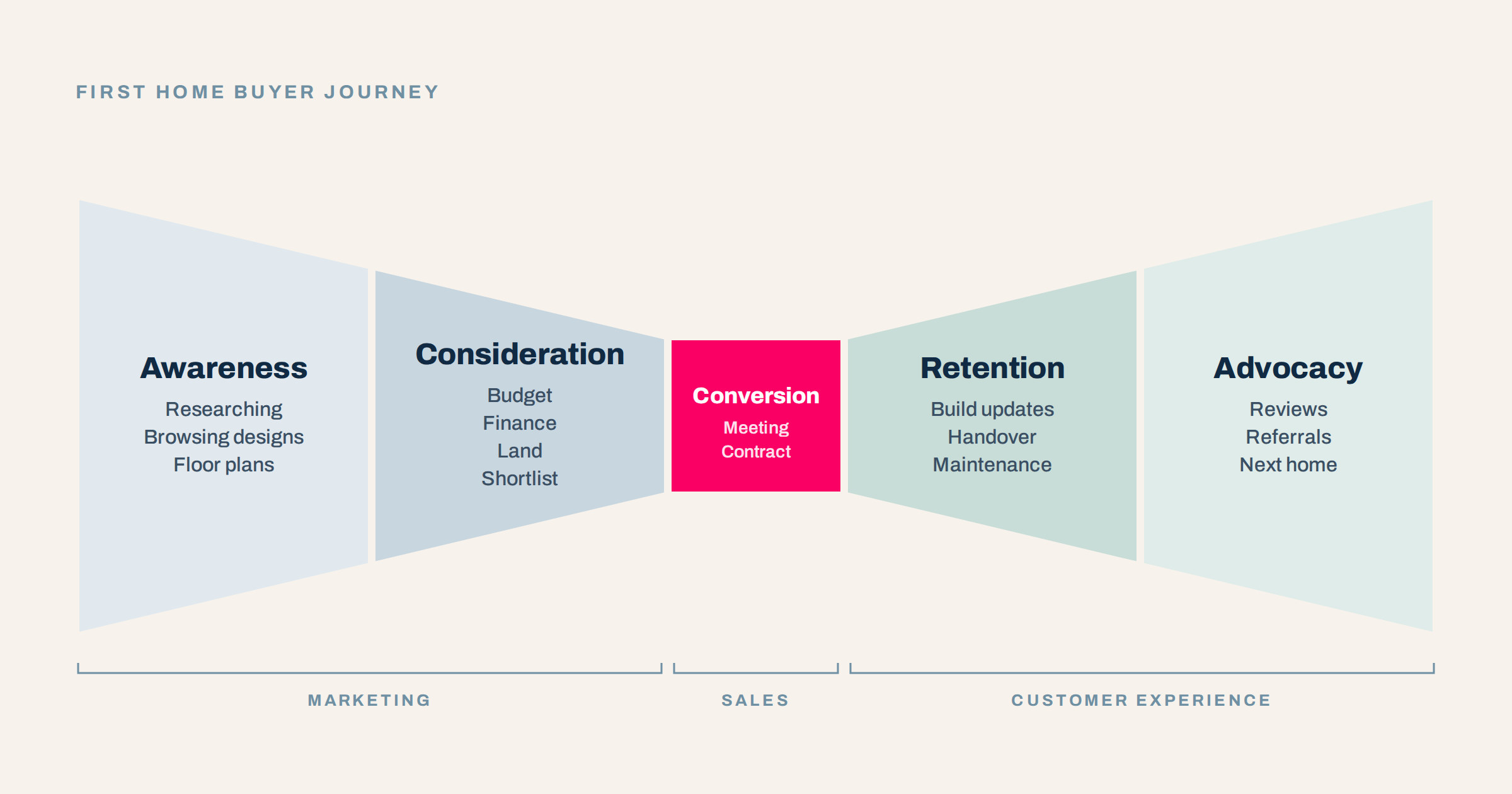
Most builders I talk to don't have a lead generation problem. They have a follow-up problem. The enquiries come in, sales responds to the ones that look ready, and the rest go quiet. Not because they were bad leads, but because they were early ones. They weren't ready to talk, so sales moves on to the people who are. Month after month that number compounds, and without automation it quickly becomes more than any team can manage.
The usual answer is "we need a CRM". That's true, but it's only half the answer. The part that gets missed is that, unless the market is very niche, builders don't have one type of buyer. You might be selling house and land packages to first home buyers, taking enquiries from downsizers, feeding stock to a network of agents, and pricing a townhouse project for a developer, all in the same week. Each of those is a completely different journey.
This article covers what a builder needs to consider, plan for and scope before committing to any one platform. That includes the buyer types your CRM has to handle, what it needs to do for each, and how to choose a platform that fits the size and ambition of your business.
Why builders need a different kind of CRM
Most CRMs are designed around a simple idea. Someone enquires, you qualify them, you quote, you win or lose. That works when the buying decision takes days or weeks. Building a home doesn't work like that.
A buyer who enquires today may be six months or more from signing a contract. They might be waiting on land to title, sorting finance, or selling their current home first. For a developer, it might be a development approval that takes months to come through. The interest is real, the timing isn't there yet, and a generic sales process treats that as a dead lead.
Long, uneven sales cycles
Timing is driven by things outside your control, like land, finance, a house sale or approvals.
Several buyer types at once
Developers, channel partners and home buyers all need different handling, and most builders deal with more than one.
Stock that has a deadline
If you secure lots to sell as house and land, the clock is running whether buyers are ready or not.
"Most enquiries aren't won on first contact. They're won by whoever is still there when the timing is finally right."
Builders don't have one type of buyer
Before choosing a platform or building a single automation, get clear on who you're actually selling to. For most builders, it's a mix of the groups below.
- First home buyers
- Upgraders
- Investors
- Downsizers
- As land partnersA supplier. Their lots become your stock.
- As clientsA B2B deal, priced or tendered.
- Agents
- Brokers
- Buyer's advocates
Home buyers
Home buyers aren't one group either, and the journey varies a lot between them:
- First home buyers need the most education and reassurance. They're often finance and grant driven, and they tend to have the longest nurture.
- Upgraders (second or third home) know what they want. They care about design and inclusions, and their timing usually depends on selling their current home.
- Investors are numbers driven, focused on yield, depreciation and rental appraisals. They decide faster and often come back for another.
- Downsizers are driven by lifestyle and location, often looking for low maintenance or single level living. The sale of the family home sets their timeline.
Developers
Developers show up in two quite different ways, and it's worth separating them.
Developers as land partners. A builder secures a number of lots through an arrangement with a land developer, and on-sells them as house and land packages. The developer is a supplier and a relationship to nurture, and the lots become stock with a deadline attached.
Developers as clients. A developer engages the builder to construct their project, for example a block of 10 townhouses. This is a B2B deal. It's relationship-led, priced or tendered, and worth a lot more per contract. It needs a proper deal pipeline, not a nurture sequence.
Agents and channel partners
Many builders sell through a network of agents, brokers or buyer's advocates, which is really selling wholesale. Generally the partner owns and manages the buyer relationship, and the builder comes in at the contract stage. That changes what the CRM needs to do. Partners need an easy way to submit a buyer so it's attached to their record, the builder needs to see which partner introduced whom, and partners need current stock and pricing without having to ask. Arrangements do vary, and some builders take over the lead, so be clear on who owns what before you build anything.
Commission matters here too. It often varies by partner, by package and by the point in the sale when it becomes payable, so the CRM should track it against each deal rather than leaving it to a spreadsheet.
As with any journey, build one core process that everyone moves through first, then define where the real variations are. Don't build six separate sales processes on day one. Build one, and let segments change the messaging, the timing and the handoff.
The buyer journey still applies, just at different speeds
For home buyers, the journey tends to run through three broad stages:
- Just looking. Browsing designs, downloading floor plans, following you on social. Interested, not ready.
- Getting serious. Land secured or being looked at, finance conversations started, a rough budget and timeframe in mind.
- Ready to build. Wants a meeting, a price, a site visit.
The stages are the same across segments, but the speed isn't. A first home buyer might spend months in "just looking". An investor might move from enquiry to ready in a few weeks. A developer skips the nurture entirely and goes straight to a conversation.
That's why the information you collect matters so much. Land, finance, budget and timeframe tell you which stage someone is really in, and they don't all need to be asked on the first form. Ask for each one at the moment it's natural to ask.
From first enquiry to sales-ready
Goes deeper into the three stages, the signals for each, and what to ask when.
Where builders lose leads
The leaks are remarkably predictable. Across the builders I've worked with, they almost always sit in the same places:
Each segment has its own version too. Channel lead submissions that never get attached to the right partner, or stall between the partner and your contracts team. Developer conversations that live in one person's inbox. Secured lots that nobody is actively matching to buyers until the deadline is close.
Almost none of these are lost leads. They're un-actioned ones. And that's exactly the part a CRM, set up properly, takes off your team's plate.
of sales take 5 or more follow-ups
follow-ups before the average rep stops
Source: Jamil Academy, real estate lead conversion benchmarks (2026)
What a builder CRM needs to do
Whichever platform you choose, these are the things it needs to handle well:
01Capture every enquiry, from every source
Website forms, portals, social ads, display homes, phone calls and channel partners, all landing in one place and tagged with where they came from.
02Know who the buyer is
Segment on entry, or as soon as you can tell, so a developer never receives a first home buyer email.
03Track the stage, not just the status
Just looking, getting serious or ready to build, based on the information you've collected.
04Collect information progressively
Land, finance, budget and timeframe, asked at the right moments rather than all on the first form.
05Nurture automatically
Relevant follow-up by email and SMS for every segment, so no one goes quiet just because sales is busy.
06Hand off at the right time
A task or alert for sales the moment someone becomes ready, with the context they need to pick it up.
07Manage partners and stock
Referrer and commission tracking for channel partners, and lot-level status (available, on hold, sold) with key deadlines if you sell house and land.
08Run B2B deals separately
A distinct pipeline for developer projects, with its own stages and reminders.
If your current setup can't do most of this, it's not a CRM problem to fix later. It's revenue quietly leaving now.
Before you commit to a platform
The most expensive CRM mistake is choosing a platform before you know what you need it to do. A few hours of scoping up front saves a lot of rework later. These are the things to work out first.
| Theme | What to work out |
|---|---|
| Your buyers | Which buyer types you sell to, roughly how many enquiries each brings, and every source they come from |
| Your process | What you need to know at each stage, and whether you manage lot stock and its deadlines |
| Your systems | What it needs to connect to (build software, portals, accounting), and what data comes across from existing systems |
| Your team and budget | Who will use it and how you'll get them using it, setup and ongoing cost, the reports you need, and where the business will be in two to three years |
Start with a phase 1
You don't need to build everything on day one. Scoping tells you what the full picture looks like, then you decide what's good enough to start with. For most builders, a sensible phase 1 looks like this.
- Every enquiry lands in one place, tagged with its source
- An automatic response goes out within minutes
- One core pipeline covers just looking, getting serious and ready to build
- One nurture sequence looks after buyers who aren't ready yet
- Sales gets an alert when someone qualifies
- Segment-specific nurture
- Channel partner reporting
- Lot stock tracking
- Integration with build software
- Deeper reporting
The point of scoping first is that phase 1 is built on the right foundations, so phase 2 adds to it rather than replacing it.
Choosing a platform
What about build management software?
Many builders already run a build management platform, such as ClickHome or Buildxact. These are excellent at the build side, from scheduling and selections to variations and client portals. Most include a CRM and some basic sales features too.
Where they tend to fall short is marketing automation. Segmented, multi-stage nurture across several buyer types needs a proper marketing layer, either on its own or connected to your build platform. That's usually where one of the three platforms below comes in.
GoHighLevel, HubSpot or Salesforce?
The right answer depends less on features and more on the size of your business and where you're heading.
GoHighLevel
Smaller, budget-conscious builders with only one or two different sales processes, who want fast SMS and email follow-up in one place, and don't need a platform built to scale.
GoHighLevel servicesHubSpot
Growing builders adding sales staff, regions or new buyer segments, who want strong marketing automation their team will actually use.
HubSpot servicesSalesforce
Larger or more complex operations, such as developer projects, multiple entities, channel partner networks, or deep integration with build systems.
Salesforce servicesPut simply, if you sell mainly to home buyers and want to keep things lean, GoHighLevel is a great fit. Once developers, channel networks and rapid growth are part of the picture, HubSpot or Salesforce will serve you better in the long run, and save you a painful migration later.
What it looks like in practice
Here's how one CRM handles two very different relationships at once. The names are made up, the scenario is common.
Mark, the land partner
Mark is a land developer releasing a 40-lot estate in a growth corridor. The builder has worked with him before, so he's in the CRM as a land partner, not a lead.
The builder secures 8 lots through an arrangement with Mark. Each lot goes into the CRM as stock, with its package price, its status (available, on hold, sold) and the date the builder needs to commit by.
Sarah, the first home buyer
Sarah is a first home buyer who downloaded a floor plan from a social ad three months ago. The CRM tagged her as a first home buyer at the "just looking" stage, and she's been receiving an education series since. It covers how building works, what the first home grant includes and how construction loans are paid out in stages.
Along the way she's told you her budget and that she's pre-approved. She hasn't found land yet.
Where they meet
When the 8 packages go live, the CRM does the matching:
- Channel partners get the new stock automatically, with pricing and a package flyer.
- Buyers in the database whose budget and location fit get an email about the release. Sarah is one of them.
- Sarah opens it twice and clicks the pricing. Her stage moves to "getting serious", and sales gets a task to call her with the context already in front of them.
As the deadline with the land developer gets closer
The CRM keeps an eye on that date so nobody has to:
- 60 days out, channel partners get first access, before the lots are released to the wider public.
- 30 days out, the final lots are matched to direct buyers.
- 14 days out, the builder has a clear picture before deciding whether to commit to more.
One platform, two relationships, very different handling. Mark needs a partnership and a deadline tracked. Sarah needs months of patient, relevant follow-up. A generic CRM would treat them both as "contacts", and miss what matters about each.
- Releases a 40-lot estate
- Builder secures 8 lots
- Each lot added as stock: price, status, commit date
- Downloads a floor plan from a social ad
- Three months of education emails
- Shares her budget and pre-approval
Get the new stock automatically, with pricing and a package flyer.
Whose budget and location fit get an email about the release.
Opens it twice and clicks the pricing. Stage moves to "getting serious" and sales gets a task.
Channel partners get first access, before the wider public.
The final lots are matched to direct buyers.
A clear picture before deciding whether to commit to more.
A quick self-check
Three questions to ask about your current setup:
- If a buyer enquires today and isn't ready for six months, will they hear from you in month four without anyone remembering to send it?
- Can you see, right now, which enquiries came from which platform or channel partner?
- Does sales get told when a quiet lead becomes active again?
Every question you can't answer yes to is a point where leads are slipping away.
The full eight-question self-audit
It's inside From first enquiry to sales-ready, along with the buyer stages and what to collect at each one.
Frequently asked questions
What is the best CRM for builders in Australia?
It depends on your size and ambitions. Smaller builders focused on home buyers often do well with GoHighLevel. Growing builders adding regions or segments tend to suit HubSpot. Larger operations with developer projects and channel networks are usually best on Salesforce.
Can I use my build management software as my CRM?
For managing leads, often yes. For segmented, automated nurture across several buyer types, most build platforms are limited. Many builders connect a marketing platform alongside their build software rather than replacing it.
Can one CRM handle developers and home buyers at the same time?
Yes. The key is one core process with separate pipelines where the journey is genuinely different, such as a B2B pipeline for developer projects alongside the home buyer journey.
How do I manage leads from channel partners?
In most arrangements the partner manages the buyer, so the priority is making it easy for them to submit a lead that attaches to their record, keeping them supplied with current stock, and tracking commission. Your CRM then takes over at the contract stage, with the partner's details already attached.
How long does it take to set up a CRM for a building business?
It depends on how many segments and systems are involved. A focused setup for home buyers can be up and running in weeks. Adding developer pipelines, channel partners and build software integration takes longer, which is why mapping the journey first saves time.
Where to from here
Start with who you sell to. List your buyer types, then walk each one from first enquiry to contract and mark where they go quiet. That map tells you what your CRM needs to do, and which platform fits. The customer journey mapping article walks through the method step by step.